
Digital Signage Blog Archives


Posts Tagged ‘marketing’


Guest Post Digital Signage: How to Get It and Why It Should Be Utilized

Written by Guest Blogger: Bryan Cochand

Communication is crucial to any type of business, but choosing the right way to communicate can be challenging. digital signage — a term for publicly displaying important information and announcements on a large plasma, LED, or LCD screen — is a cutting-edge method for businesses or organizations to get their message out to their consumers in an economical and flexible way. Catching up to all the advantages of this method can be an easy and very lucrative improvement. So if you are looking for new methods to increase the exposure of your company or organization, it may be worthwhile to check out the benefits of using digital signage.

continue reading »

Category: Digital Signage Blog News, Digital Signage Guest Posts


Digital Signage and audience measurement tools

Last year we noticed a number of companies launching their audience measurements tools as part of their digital signage solution. The solution normally consists of a digital screen, server, digital signage player and a webcam. By using the webcam, the software tool detects and counts the number of people who are looking at the screen. For some solutions, it can even go beyond just tracking this number and determine what gender and age the person that looked at the screen was.
You may be asking yourself, “Do I really need this solution?”. If you’re a marketing or advertising company then yes, this information is critical. Using raw data and number to present to your advertisers will make a compelling reason why they should advertise on your screens.


Do you use audience measurement tools in your digital signage solution?


View Results

Loading ... Loading ...

Category: Digital Signage Blog News


Static Displays to Digital Displays

Using a digital display instead of a static display is as easy as 1-2-3. Over the years, we realised how a large percentage of retail owners are hesitant and reluctant in using a digital display because no one took the time to clearly explain what the benefits are in using digital signage. The majority of them are still installing and purchasing static displays i.e lightboxes and posters which is a bit of a waste of money.

Yes, its true that the cost of digital displays is generally higher than the static display – there’s no doubt about that. But here’s why you should still consider in using a digital display:

1. Printing costs – there are no printing costs involved with digital displays. If done correctly, you don’t even have to spend too much money with design costs as you may already have existing content from your website or marketing material.

2. Resource costs – how much time is spent replacing static images. Wouldn’t it be more effective if your staff was actually serving customers rather than spending time hanging posters?

3. Animation and engaging content – this is used to attract more customer into your store.

4. Live information – e.g news, weather, twitter posts, facebook information, you can’t do this with static display!

The switch is easy… just contact advertise me and we’ll take care of everything for you.

Category: Digital Signage Blog Info


Digital Signage at Adelaide Airport

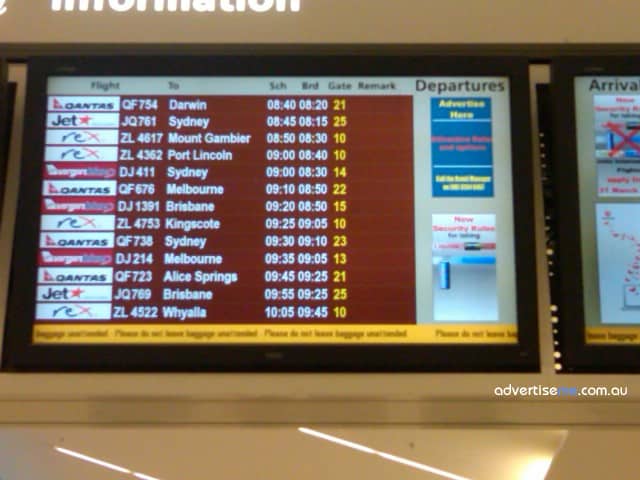
Several weeks ago I was in the Adelaide airport and I was surprised on how different the airport digital signage screens was being used and implemented there. This is what I saw:

Digital Signage At Adelaide Airport

Digital Signage At Adelaide Airport

If you look at the screen closely, you’ll notice that on the top right hand section there is a banner stating “Advertise Here…”. This is the first time I’ve seen an airport trying to promote advertising space which is great to see.

Digital Signage At Adelaide Airport

Digital Signage At Adelaide Airport


Category: Digital Signage Blog Info


Screen Dilemma: Native vs Maximum resolution

This seems to be a common dilemma amongst a number of LCD/Plasma decisions in a lot of tender projects and client requirements. Do clients really know what they are asking for, and how important is screen resolution for digital signage rollouts?

Let’s clear a few things up first.

What is Native and Maximum resolution?

Native resolution is the fixed number of pixels on the screen. For example, if your screen has a native resolution of 1280×720 pixels, this means your screen is physically made up of 1280 pixels wide and 720 pixels high.

Maximum resolution is the highest resolution that the screen is capbable to display.

Conversion and Scaling

When an incoming signal to the screen does not match the native resolution, that signal must be converted (or scaled) to be displayed correctly on the screen. So lets use the same screen above, it has a native resolution of 1280×720. If an incoming signal is 1920×1080, the screen will scale this resolution down so that it can fit on the physical dimensions of 1280×720. Likewise if an incoming signal is 1024×768, then the screen will up-scale this resolution to fit 1280×720.

This process is possible because the screen has been programmed to recognise different input signals and to convert them as such. More often than not you will have a list of all the supported input signal resolution sizes, and the highest supported resolution is your Maximum resolution.

Now that we have that out of the way, lets talk about how important is screen resolution in digital signage?

In all my digital signage years until now, I have not had to focus on optimising the quality of the display in regards to picture sharpness and contrast ratio. The general technology of the Plasma/LCD screen makes up for this. What comes out of the digital signage player is just right for the display quality. The general conversation would be on how to most effectively capture consumers attention with the type of content and how it is designed.

However recently in Australia, digital broadcasting of TV networks have become more prominent and consumers are now well aware of terms like HDTV. This presence of high definition television has entered many homes and now the retail store fronts want to show this off also. Because consumers are already aware of such technology, there is an expectation on store owners to provide this service to them.

The question comes back to client requirements. Do most clients have the proper knowledge to determine what screens they want based on what they know or what they have been told? Is it important to match the right resolution of what is coming from the digital receiver into the digital signage player, and out to the screen?

We’d like to hear your point of view on this topic. There is no right or wrong answer, as each requirements are different, but we would like to hear your thoughts.

Category: Digital Signage Blog Info, Digital Signage Techie, Featured Post


Digital Signage at the Melbourne Retail Expo 2009

It was a worthwhile trip to Melbourne for the 3 days Retail Expo. Apart from the general retail equipment and conventional display signage, in my opinion it was digital signage which took the light of the show.

At the centre of the show (I do mean right at the centre on the floor) showcased the Retail 2020 – Store of the future. Having said “store of the future” one would start to think automated customer interaction (without having to input anything into the screen), focused one-to-one marketing in personalising each customer’s experience – and that’s what it did. Picking up a pair of trousers and bringing them in front of a screen will trigger a video, Barcode scanners that control and manage content, just to name a few.

Traffic monitoring was also a feature that couldn’t be left out. People counting and activity flow were the main items on the list. However I would have liked to see eye tracking and facial expressions data, and possibly gender and age group contributing into the demographics.

Overall I am quite happy to see more strategies in improving customer experience – customer focus. Although one can argue to say it is what you do with the content that drives consumer decisions, which is true. What I was afraid of was only seeing back-end technologies in which we have all already seen and used over these many years. With automated customer interaction, one can add to the efficiency by customising (and market) the content to be more effective for the customer.

Did you visit the Melbourne Retail Expo 2009? Please share your experience with us.

Category: Digital Signage Blog Events


Webinar: Digital signage – More important than ever in an uncertain economy

Here’s the next upcoming webinar. It is hosted by digital signage Today and seems like it is sponsored by Cisco. Based on the agenda it seems like the host will be marketing the Cisco Digital Media player. We previously posted an article called Cisco Digital Signage Demo – digital signage portal have a quick read.

This is an informative webinar to learn how digital signage can revive your business’ communication, and how the network-based Cisco Digital Media System can help you remain competitive and build strong relationships with both your employees and customers.

Don’t miss this complimentary and informative webinar that will cover:

  • Why digital signage is unique in addressing current economic challenges facing businesses
  • How you can leverage both digital signage and desktop video within your organization
  • The benefits of a centrally managed, network based digital media solution
  • Planning and deployment examples

To register click here.

Date: Tue, Feb 10, 2009
Time: 2:00 PM EST
Duration: 1 hour


Do you find webinars useful?


View Results

Loading ... Loading ...

Do you have an upcoming digital signage event? Add it to the events calendar and share it with other members of the digital signage portal.

Feel free to submit your answer as a comment.

Category: Digital Signage Blog Events, Digital Signage Blog Info


Redefine: What is digital signage?

Since it’s the start of the new year, we decided to go “back to basics” and decided to re-look at the definition of “Digital Signage“. So we scouted around the web to find various definitions and here’s our list:

To start off the ranks, here’s the definition from advertise me:

Everybody knows the conventional method of using posters to deliver messages, whether it is to sell a product or service or to inform the audience.

Using a digital signage player, Digital Signage takes this traditional approach of delivering messages and allows for the greater control and flexibility over how the message is delivered on a digital screen.

Digital Signage is the use of digital technology such as a digital screen, digital signage players and software to deliver content such as information, advertisements and entertainment to a captive audience…

Source: http://www.advertiseme.com.au/content/DigitalSignage.Home.asp

Digital signage is a form of electronic display that is installed in public spaces. Digital signs are typically used to entertain, inform or advertise (together known as “adfotainment”). Major benefits of digital signs over traditional static signs are that the content can be exchanged more easily, animations can be shown and the signs can adapt to the context and audience, even interactively…

Source: http://en.wikipedia.org/wiki/Digital_signage

Digital signage, also called dynamic signage, is a specialized form of slivercasting in which video or multimedia content is displayed in public places for informational or advertising purposes. A digital sign usually consists of a computer or playback device connected to a large, bright digital screen such as an LCD or plasma display…

Source: http://searchcrm.techtarget.com/sDefinition/0,,sid11_gci1197791,00.html#

Digital Signage, by definition, is an electronic billboard system, used to present dynamic information electronically, on flat panel displays such as LCD, Plasma or DLP Projectors. Wherever you need to advertise, educate or inform customers, consumers, staff, students or partners, digital signage is a fast, reliable and simple way to get your message heard…

Source: http://www.nec.com.au/74c02936e97b44d8bf739b99ab4b75c7.htm

Digital signage is remotely controlled distribution and playback of digital content across networks of displays. It is used for delivering visual messages at point-of-purchase, or at any other public venue…

Source: http://www.broadsign.com/digital-signage/digital-signage.html

A most simplistic definition of digital signage is that of a “remotely managed digital display, typically tied in with sales, marketing and advertising.”

Source: Page 2 of the Digital Signage Book by Jimmy Schaeffler.

Digital signage refers to electronically controlled signs that you can update on-the-fly, without having to touch the physical sign itself. You can change the content quickly and inexpensively, and deliver targeted messages to hundreds or thousands of displays at once. These dynamic displays are often used to present a custom-tailored mix of informational and advertising content, including product promotions, timely news, and upcoming events…

Source: http://www.wirespring.com/Solutions/digital_signage.html

There may be more definitions but we couldn’t obviously put them all here in this post. What we found common amongst most of the above definitions is that some are refeering to digital signage as being able to “remotely manage” or located in “public locations” - I don’t necessarily think this is the case. Standalone units which can have the content updated via a media card would not fall under this definition. There are also several businesses that use digital signage for internal communications and don’t necessarily have the display screens located in public locations. So maybe lets all collaborate and redefine this term.

What is your definition of digital signage?

Feel free to submit your answer as a comment.

Category: Digital Signage Blog Info, Digital Signage Blog News, Digital Signage Techie

Request a Digital Signage Quote

RSS

Or subscribe via email:
 
Digital Signage Blog Sponsors

Advertise Me Sponsorships available here!

Digital Signage Articles

Sponsored Links


Recent Comments: