Digital Signage Blog Archives
Archive for Category: ‘Digital Signage Interview’
Advertise Me interviews Flypaper – Digital Signage Software
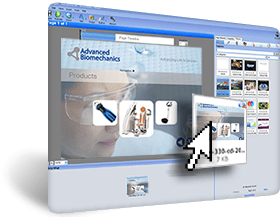
We had the opportunity to interview Don Pierson from Flypaper, a company that provides digital signage Software for agencies, developers and businesses to quickly create, share, collaborate, edit, reuse and track digital signage content without any programming.
Don Pierson is the founder and president at Flypaper where he is responsible for delivering rich, interactive e-learning, digital signage, and marketing content to corporate clients. Pierson has two decades of experience in the interactive communications industry. In 2003, he founded Interactive Alchemy and as CEO drove a successful services business that fulfilled the communication and training needs of marquee clients including MetLife and United Airlines. Using the proceeds from the success of Interactive Alchemy, Pierson created a collaborative development tool called Catalyst. By 2006, Pierson identified a broader applicability for the Catalyst solution, and set out to develop what is now Flypaper. He holds a BA in management from Arizona State University, with honors.
As a bonus we’ve managed receive a promotion for our readers… so read the interview for the promotion – you will not be dissapointed!!
Category: Digital Signage Interview, Featured Post
Advertise Me Interviews Christie MicroTiles
Interview with Richard Heslett, product manager, Christie® MicroTiles™, Christie Digital Systems USA, Inc. He is responsible for product lifecycle management: identifying and evaluating market opportunities, defining product requirements and developing sales and marketing strategies.
| advertise me: | Hi Richard, thanks for joining us for this interview and welcome to the digital signage blog. |
| Christie: | Thanks. It’s a pleasure to meet you and your readers! |
| Advertise Me: | For our own records, how did you first come across or hear about the digitalsignageblog.com? |
| Christie: | Your site targets many of the key industry players in digital signage who are interested in the latest developments, trends and products that can help them do their jobs better. We believe it is an excellent venue for connecting to that target audience. |
| Advertise Me: | Could you please briefly explain to our readers about the product? |
| Christie: |
Christie® MicroTiles™ are the new digital canvas, comprised of lightweight tiles that lock together quickly and easily, like building blocks, to form a digital display of any shape or scale. They are specifically designed for maximum image quality in indoor, high-ambient light environments and are ideal for a wide range of demanding applications. Leveraging the strengths of both DLP® projection and Light Emitting Diode (LED) technology, Christie MicroTiles offer substantially brighter images and a much wider color palette than conventional LCD and plasma displays. Physically, each tile is 16 inches (408mm) wide x 12 inches (306mm) high with a shallow depth of only 10 inches (260mm), and requires just 2 inches (50mm) of clearance for rear ventilation, so they can be installed practically anywhere. |
| Advertise Me: | Please tell us a little about how MicroTiles started and what was the inspiration behind the business? |
| Christie: | Like all great inventions and revolutionary concepts in the business world, the idea for MicroTiles began with a rough sketch on a hotel napkin! MicroTiles inventors Bob Rushby, Mike Perkins and Larry Paul were sitting in a Tokyo hotel bar several years ago, when the idea first started to take shape. Dissatisfied with the trend of using conventional flatscreen panels for public displays, they started talking about how to integrate digital media directly into the built environment in new and exciting shapes and aspect ratios that would capture people’s attention and support the architectural design of the space. They thought to themselves: “Maybe we can turn the display technology into an integral design element instead of an afterthought …” And so, after much research, testing and customer feedback, MicroTiles were born. |
| Advertise Me: | How long did it take to develop the MicroTile technology and then market the product? |
| Christie: | From conception to final product, it took us about four years. |
| Advertise Me: | What are the benefits of using this technology over traditional screens? |
| Christie: | MicroTiles allow architects and designers to throw out the supposed rule book on how large-format display systems have to work in big spaces. With MicroTiles, they can now literally blend digital media into the built environment, and express their creativity and vision in ways that were previously impossible using conventional flat panel LCD, plasma and LED walls. Simple to setup and self-calibrating for brightness and color, you don’t need a lot of technical expertise to assemble or operate a display. Finally, MicroTiles offer more reliable and longer-lasting operation than traditional displays, and can be serviced in less than 15 minutes from the front by popping out the screen. |
| Advertise Me: | Which industries is MicroTile targeting? Is it just the digital signage industry? |
| Christie: | Christie MicroTiles are ideal for a wide range of demanding applications, including architecture, digital out-of-home (DOOH) advertising, command and control, and event production. Those are just some of the markets approaching us with strong interest. Every day, our business partners are discovering new ways of using MicroTiles that were impossible or impractical with other technology. |
| Advertise Me: | Is there a limitation to the number of MicroTiles that can be used and the shape of the canvas? |
| Christie: |
You can connect up to 1,024 tiles together to function as a single display. It is possible to build an even larger display, but each section of up to 1,024 tiles must be controlled and calibrated by a separate group of External Control Units (ECUs). The configuration of the “digital canvas” is limited only by your imagination and the physical limitations of the space. |
| Advertise Me: | Can the MicroTiles be used for outdoor purposes? |
| Christie: | MicroTiles should only be used outdoors if they are enclosed and protected from such conditions as extreme temperatures, high humidity, precipitation and sunlight. The brightness of MicroTiles is insufficient for direct sunlight applications. |
| Advertise Me: | Is the system limited to the type of video input it supports? |
| Christie: | Single-link DVI is the only input supported at this time. |
| Advertise Me: | What has been the most successful and popular MicroTile project thus far? |
| Christie: | MicroTiles was official launched on November 11, 2009 in North America, and already we have installed our first system for a high profile customer and have a backlog of orders for a wide variety of innovative applications; but unfortunately, none that we can reveal at the present time due to customer confidentiality. We can say, however, to stay tuned for some exciting announcements. A number of launches are scheduled throughout the Asia Pacific region in March, April and May of 2010. Visit our website for show and launch updates. |
| Advertise Me: | What is the MicroTiles Designer? |
| Christie: | MicroTiles Designer is a free software program provided by Christie that lets you quickly plan a MicroTiles display and see how it will look in your space. MicroTiles Designer will also tell you the energy consumption of the display, how much it will weigh, and the optimal way to wire the tiles together. A simplified online version, the MicroTiles Calculator, will give you a sense of the capabilities and application of Christie’s MicroTiles for your digital display requirements. |
| Advertise Me: | Do you have any advice for people who are planning to start a business in the digital signage industry? |
| Christie: | The digital signage industry is a rapidly evolving and exciting industry, so be prepared for a turbulent and exciting ride! |
| Advertise Me: | If someone is interested in this product, who would they contact and how much would it cost? |
| Christie: | The best way is to click on the MicroTiles website, www.microtiles.com and fill out our quick information form to have a sales representative in your area contact you, or to find out your nearest MicroTiles dealer. |
| Advertise Me: | This is our final question. What do you see as the next “BIG THING” in digital signage? |
| Christie: | Besides MicroTiles? Interactivity. |
| Advertise Me: | Christie, thanks for taking part in this interview and we hope to speak to you again in the near future. Hopefully, we’ll get the opportunity to see this technology being used in Australia. |
| Christie: | Thank you. We’re taking MicroTiles global, and will be launching them in the Asia-Pacific region in March, April and May this year. We invite your readers to come out to our events by registering on our website. |
To read more interviews click here: http://www.digitalsignageblog.com/category/digital-signage-interview/
About Christie
Christie Digital Systems USA, Inc. is a global visual technologies company and is a wholly-owned subsidiary of Ushio, Inc., Japan, (JP:6925). Consistently setting the standards by being the first to market some of the world’s most advanced projectors and complete system displays, Christie is recognized as one of the most innovative visual technology companies in the world. From retail displays to Hollywood, mission critical command centers to classrooms and training simulators, Christie display solutions and projectors capture the attention of audiences around the world with dynamic and stunning images. Visit www.christiedigital.com and www.microtiles.com.
Christie® is a registered trademark of Christie Digital Systems USA, Inc.
Christie®MicroTiles™ is a trademark of Christie Digital Systems USA, Inc.
About Advertise Me:
Advertise Me is a privately owned Australian company specialising in all aspects of digital signage solutions.
Our team of highly skilled professionals is able to introduce innovative ways for businesses to communicate with their intended audiences for a variety of purposes including informing, educating, entertaining and selling.
You can expect us to:
- offer the most affordable and cost effective solutions tailored to your specific business needs.
- provide you with concise and accurate information and will ensure that you understand and are comfortable with our proposals.
- strive to make our clients happy and successful.
We have partnered with a number of key reputable organisations and will continue to build further partnerships to deliver the most effective solutions for our customers.
Visit our website at www.advertiseme.com.au for more information.
Interview with Richard Heslett, product manager, Christie® MicroTiles™, Christie Digital Systems USA, Inc. He is responsible for product lifecycle management: identifying and evaluating market opportunities, defining product requirements and developing sales and marketing strategies.
Category: Digital Signage Interview, Featured Post
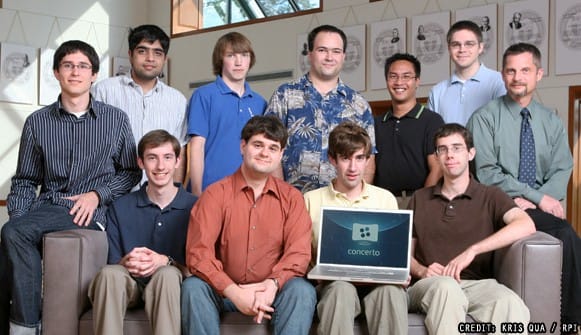
Advertise Me Interviews Concerto Digital Signage
| advertise me: | Hi Brian, thanks for joining us for this interview. We’re quite excited to speak to someone such as yourself about Open Source applications for digital signage. |
| Brian: | Thanks for interviewing me! We built Concerto as students at one of America’s great tech universities because it addressed an unmet need that we saw on our campus, and we didn’t expect when we initiated the project to see it become a topic of interest for people all over the world. |
| Advertise Me: | Let’s start with the basics – could you please explain what Open Source is, and is it really free? |
| Brian: | Sure. Open source software is free for anyone to obtain and use, as well as modify – provided that they make their modifications open-source as well. |
| Advertise Me: | Thank you for clearing that up. So let’s talk about your Open Source application for Digital Signage called Concerto. How did you come up with that name and what is it exactly? |
| Brian: | First things first: Concerto is a free digital signage platform for sharing flyers, alerts, and other messages with other people by showing them on flat panel televisions and other types of screens. It’s a broadcast medium that makes it simple to make a flyer and get it out to many people quickly, but it also allows screens to show a custom mix of messages based on predefined preferences.
The name Concerto pertains to this key function. A musical concerto emphasizes one musical instrument amidst an entire orchestra, and with our digital signage product, users can emphasize one type of message amidst an entire orchestra of different types of advertising. For example, at we launched Concerto at Rensselaer Polytechnic Institute (RPI for short). At RPI, the management school has a big screen with a special zone for graphical messages. With Concerto, they just specify the types of advertisements they want to highlight, and which types they wish to exclude. So messages about management lectures might be shuffled in more frequently than student entertainment flyers and sports notices. In this way, the management school can tailor their Concerto display for the audience they hope to attract without impacting how others on campus use Concerto. |
| Advertise Me: | Out of curiosity, how did the Concerto concept and idea start? |
| Brian: | We started Concerto with a purpose: to improve communication within our campus community. There were already ways to tell the RPI campus community about events and other happenings before Concerto: student groups, academic departments, or individuals could print out and tape up a lot of flyers, or even put their messages on the campus cable television system. It took a lot of time and money to print out and put up lots of paper signage. The cable television system was managed by a very small group of people who had many other responsibilities aside from approving messages for cable. More importantly, that system was designed with a bureaucratic, almost corporate mindset in mind, one meant to keep control of the network regulated to only the smallest group of elite users. So we designed Concerto from the ground up to be accessible to every computer user at our school. Now we have students, staff, and faculty working together to help maintain the network. It really gives people a reason to pay attention to Concerto – they become a part of campus communication, instead of just being forced to see it. |
| Advertise Me: | Why should someone use Concerto and what are some of the benefits? |
| Brian: | Members of any community where events and information are often overlooked should find Concerto’s unique design to be particularly attractive. We designed Concerto first for colleges and universities, but its benefits can extend to any community looking to spread and share messages about events and other activities.
Here are some core benefits of using Concerto:
|
| Advertise Me: | Since the application is free, are businesses permitted to resell this product to their clients? |
| Brian: | Under the terms of our license, the GNU Public License (v2), our software may be resold. But this distinction is key: no company can restrict the rights associated with a copy of Concerto by denying their users access to the source code. I’ll also add that if you make a modification to our source code, you must give back those changes to the larger community. Companies may provide for-pay support and consultation packages to get our software up and running for others, but the source code must always remain free to everyone.
|
| Advertise Me: | Can Concerto be classified as a Software as a Service (SaaS)? |
| Brian: | I guess it could be considered SaaS, but that’s not how we think most people will use it. We have our Concerto server software running on a powerful machine at RPI that serves out the content for all of the client machines across our Troy, New York campus. This server could theoretically be located somewhere off-campus, in which case every client unit would receive content over the Web. But for most administrators who wish to launch a Concerto network at a school, in a town, or elsewhere, it probably makes the most sense to locate that server somewhere nearby. I should also mention that most users of Concerto are everyday people who just want to find and share messages of interest – since they just visit Concerto in a Web browser and never see its nuts and bolts, it looks like a service that could be hosted many miles away from them. |
| Advertise Me: | Could you please briefly explain what would be involved (hardware & software) in setting up a digital signage solution using Concerto? |
| Brian: | Concerto is designed from the ground up to work perfectly with inexpensive, commodity hardware that anyone can purchase from websites such as Newegg.com. There’s a central server, as I already described, which is simply a computer that stores content and distributes it to each Concerto screen. The first step to deploy Concerto is to download our software at http://www.concerto-signage.com and install it on the computer that will act as the content server.
Once that’s set up, you’ll need some other computers to drive the different displays on your fledgling Concerto network. The system requirements for these units are much lower – we’ve been successful with $500 small form factor computers that have 2 GB of RAM, Intel Celeron M CPU, Ethernet connection, CompactFlash card, and DVI connection that can then be adapted for HDMI output to flat panel televisions. These client units use the Concerto player software, which can be run as a live CD or installed directly to a storage device such as a hard drive or memory card. They must be able to connect to your network and receive power. For more information about how to deploy Concerto, please see the page at http://www.concerto-signage.com/view/deploy. |
| Advertise Me: | How long has it taken to develop the Concerto framework and application? |
| Brian: | We started to develop Concerto in October 2007, and launched it in March of 2008. We were all students at the time in our undergraduate studies at RPI. Since our RPI launch in March 2008, we’ve updated the core software over ten times, adding new features and addressing bugs in response to feedback from our more than 1,000 RPI-based users. |
| Advertise Me: | What makes Concerto so different from all the other Open Source applications in the market? |
| Brian: | Concerto first sets itself apart from many more traditional digital signage networks by being completely based on the World Wide Web. Older signage platforms were often based on coaxial cable lines. Concerto runs over standard Ethernet cable and wireless Internet, which makes it far more versatile for many places that now have more Internet jacks than coaxial hook-ups. More importantly, Concerto displays can show content that is completely specific to a location and/or audience. Finally, Concerto is designed from the ground up to encourage hundreds or potentially thousands of users to get involved in the process of sharing messages about events and other information. |
| Advertise Me: | What has been the most successful Concerto project thus far? |
| Brian: | Our first and most successful network is still at RPI, but we just released the source code under our public open source license in July, so we are also working with several groups from around America to launch Concerto in their own communities. While I can’t talk specifics yet, we’ve received inquiries from companies, libraries, and other universities. |
| Advertise Me: | Do you have any advice for people who are planning to start a business in the digital signage industry? |
| Brian: | I would suggest that the digital signage space is ready for some new ideas. Digital signage software has traditionally been proprietary and expensive. Concerto is a free alternative that provides, for the most part, the core digital signage package. In order for future companies to be successful in this space, I think they need to do more than continue to provide the same types of products and services that we can now give away for free. The bar needs to be raised, with offerings that provide an even greater value proposition than before. |
| Advertise Me: | Are there any plans to monetize Concerto? How are you guys going to make money, or is this a hidden secret? |
| Brian: | Concerto started as a volunteer project, and we decided early in the game that we would not attempt to monetize the software itself. We have no hidden agendas or secrets when it comes to that. While some of our team may consider becoming digital signage consultants in the future, we will never charge for the code. |
| Advertise Me: | This is our final question that we normally ask all of the people we interview. What do you see as the next “BIG THING” in digital signage? |
| Brian: | We have built a platform with Concerto to enable the core features and functionality of what I like to call a “twentieth century digital signage platform.” People can buy inexpensive commodity computer hardware, connect them to small or large monitors or television displays, and build a Web-based communication network in virtually any place where there’s easy access to an Internet connection. It’s a framework of functionality that nobody has to build anymore. Instead, they can focus on what they can add to Concerto to make digital signage more effective for new audiences. Nowadays, people are looking for new ways to interact with the information that’s being spread around the world. Social networking really put the focus back on the end user, and we feel that digital signage can be made more effective by providing more ways for users to interact with the advertising they see.
One of the ideas that we’re exploring with Concerto is how we can allow direct user interaction with digital signage. As the first and simplest way of enabling this kind of exchange, we’re adding pause and rewind buttons to our screens that will allow people to stop on specific messages and roll back to what they may have missed earlier. But what I think we’re really aiming to build is a full-blown kiosk mode that gives users new abilities to find out more about specific messages and other location-based information relevant to the Concerto display and its location. For example, let’s say that I’m looking at messages playing on a Concerto screen in the lobby of a hospital. When I move close to the screen, a web cam detects my presence and the display changes to show a smaller version of the same advertisements, as well as a building map and other hospital information. I think that a new and greater push for designing experiences that combine advertising with interaction can help us to create a new type of digital signage. |
| Advertise Me: | Brian, thanks for taking part in this interview and we hope to speak to you again in the near future. Good luck with the Concerto project and we wish you all the best. |
To read more interviews click here: http://www.digitalsignageblog.com/category/digital-signage-interview/
About Concerto:
Concerto is a free, Web-based broadcast medium for digital announcements that just works. Using Concerto, it’s easy to engage large communities of people with graphical and text-based flyers, alerts, and other messages. The open source project was initiated by undergraduate students at Rensselaer Polytechnic Institute in 2008. The code can be downloaded for free at http://www.concerto-signage.com. The Concerto Project is open to developers from around the world and aims to provide a free platform for digital signage today and in the future.

About Advertise Me:
Advertise Me is a privately owned Australian company specialising in all aspects of digital signage solutions.
Our team of highly skilled professionals is able to introduce innovative ways for businesses to communicate with their intended audiences for a variety of purposes including informing, educating, entertaining and selling.
You can expect us to:
- offer the most affordable and cost effective solutions tailored to your specific business needs.
- provide you with concise and accurate information and will ensure that you understand and are comfortable with our proposals.
- strive to make our clients happy and successful.
We have partnered with a number of key reputable organisations and will continue to build further partnerships to deliver the most effective solutions for our customers.
Visit our website at www.advertiseme.com.au for more information.
Category: Digital Signage Interview, Featured Post
Advertise Me interviews Blue Pony
| advertise me: | Hi Nathan, thanks for joining us for this interview. |
| Nathan: | No problem we appreciate the opportunity for conversation. |
| Advertise Me: | Could you please tell us a little bit about Blue Pony, and it’s history? |
| Nathan: | Blue Pony emerged in July of 2004 as a custom content creation company. We were formed by the owners Joel and Keersten Nichols. Joel and Keersten recognized the digital trend and the industries forming and embracing new technologies. We started creating content for the entertainment industry for concert tours. Our content has been used on tour with Sara McLachlan, Poison, the Eagles, in the Movies with Alvin and the Chimpmunks, and on TV with American Idol and America’s Got Talent. Along the way we found a natural fit creating great content for other industries. We felt especially at home with the growing digital signage Industries. We feel quality content is a need across all industries utilizing visual media. |
| Advertise Me: | I really like the Blue Pony Logo, how did the company come up with that name and the inspiration for the logo animation? |
| Nathan: | Thanks, we get a lot of compliments on it. Our sister company, Apollo Design Technology, makes lighting accessories like gobos, gobo rotators, gel, and more for the lighting entertainment industry. Our owners named Apollo after their beloved horse they received companionship from for 23 years. Unfortunately, Apollo passed away last spring. It seemed natural to build the new company sporting the name, Blue Pony. |
| Advertise Me: | In the digital signage industry, the term “Content is king” can sometimes be misinterpreted. What is your explanation for this statement? |
| Nathan: | I look at it this way. You can have the greatest technology to playback, display, schedule, and report with but at the end of the day the content playing back is what counts the most. There are certainly other variables that must align to add to success like location and placement, but effective well designed content is crucial. If the content is not effective the viewer won’t be engaged. If the viewer is not engaged by the content it is not an effective advertisement. Ineffective advertising is not likely to be renewed by the advertiser. |
| Advertise Me: | Thank you for that explanation. Now ,what type of content does Blue Pony supply and what is so different about the content Blue Pony supplies? |
| Nathan: | Great looking, well designed content is a great first step. What makes it kingly is matching it to the demographic (matching the style and material to the right group), dwell time requirements (what are the conditions of the environment? How much time do we have to communicate the message?), and environment (Making sure the content looks and feels at home and not odd and awkward). We create custom tailored content with an efficient and effective design process. Our design staff is experienced with Digital Signage ads and they have developed a thorough understanding on how to create effective signage content. We believe firmly that unique, custom content is important that is why even our “stock content” offering has a custom aspect. |
| Advertise Me: | What is the difference between stock and custom content? |
| Nathan: | In addition to a completely custom content option we have a content line in development called, Quick Designs. A Quick Design is a base design created by our design staff. The animation can be chosen as a spring board for design and we can plug in logos, images, and different text call-outs. We can even make color changes too. When you choose a Quick Design, one of our skilled designers will ensure your completed ad will look great. We feel it is better than a “template” that inevitably doesn’t quite work for whatever reason. Plus a template will likely look just like the one the other guy bought.
We also have a line called Dash Packs and regular stock background loops. Some of our Dash Packs are themed filler material for your network. Holiday greetings and celebrity birthdays are some that we have offered. http://digitalsignage.bluepony.com/content-options/dash-packs/ We never stop creating content, whenever we have time we work on new motion backgrounds to add to our online web library of stock content. Stock background loops are used across many industries. They are affordable and can be combined with other elements to create unique looks. http://www.bluepony.com/shop/ |
| Advertise Me: | How does the company source content material, e.g images, video footage etc? |
| Nathan: | Many times the material is supplied by the customer. They may provide a logo or product images. Because we have an in-house production company we are able to acquire our own stock video and photography. Furthermore, we have access to many royalty free image sources for use in our content. |
| Advertise Me: | In this digital age, content can be easily sourced from the net and some businesses and customers don’t realise that they are breaching copyright laws when using someone else’s content. What are your thoughts on this and does Blue Pony track where their content ends up? |
| Nathan: | We can’t stop it no matter how fancy we make the code. However, we are protective of our clients’ content and not every ad we produce makes it to our website. The entire process of ad development happens securely within our client preview portal. Everything is secure and access is only granted to the necessary individuals. In addition we offer our customers free mock content that we have developed. We learned quickly that most digital signage networks just need something to show their first clients by way of example until we build up a content portfolio that they can use for future sales. |
| Advertise Me: | Could you please briefly explain what steps and processes are involved when developing content. |
| Nathan: | I’d tell you but then I’d have to… No problem. We use all the usual software one would come to expect from a video, motion graphic design house. The differences are that we invest in the top of the line workstations that render video files pretty quick. We stay up to date with costly plug-ins, new fonts, and equip our production team with the best tools for content creation. That being said the process in brief goes like this. You contact us for content, we ask a few questions about your requirements or have you complete our content request form. The form gathers the details we need to determine a price to develop your content. We then generate an estimate and send it to you for approval. Upon approval of the estimate we schedule your content for production and email you a link to the project directory we create. This directory is where you can upload assets for production and it is also where our designer will place a preview for you to review your content. You would receive a link to review the content and would be able to provide feedback directly within the content timeline on the preview page. We implement any revisions you request and seek approval on the content. Upon approval we prepare the output file exactly to your specifications. You then can download your final content directly from the project directory. And repeat! |
| Advertise Me: | From past experience, how long should the content be displayed on the screens for? |
| Nathan: | It really depends. Site research might reveal the average frequency of visitors. If they see it once or twice that’s great. But if they have already processed the information and see it too many times they will tune it out and ultimately ignore the screen altogether. Two Weeks would be a sweet spot, in my opinion, but it does depend on the venue. |
| Advertise Me: | What makes Blue Pony so different from all the other content providers? |
| Nathan: | Experience, Customer Service, Quality, and Value. Customer Satisfaction is really important to us. When you engage Blue Pony you don’t just get a designer, you get an entire team of professionals who understand your business technology and goals. We realize without our customers success we will not succeed. |
| Advertise Me: | What has been the most successful and challenging content developed thus far? |
| Nathan: | Interesting. Hmm, well it is all challenging to determine how to best develop the next piece, but that’s the fun in it. Success? I hope the majority of our ads have had a shining moment but we rarely get to hear of there stardom. We seek feedback for our clients and get it from time to time. Bust most of the time we are like the auto repair shop and only hear from the customer when a new set of tires are needed. |
| Advertise Me: | Are you able to share some general pricing information with our audience? |
| Nathan: | Sure. Generally speaking all of our ad pricing is based on a rate of $135 per hour. That only is helpful to know if you have the other variable…How much time? On average a standard 20 second motion ad will cost $350. A premium ad of the same duration might average out at $500. What’s the difference between Standard and Premium? Purely time. If a premium budget is specified by the client we give our designer more development time which in turn translates to a more refined or sophisticated content piece. |
| Advertise Me: | This is our final question that we normally ask all of the people we interview. What do you see as the next “BIG THING” in digital signage? |
| Nathan: | Interactive signage and deeper integration to the personal technologies people carry, like cell phones, ipods, ect. |
| Advertise Me: | Nathan, thanks for taking part in this interview and we hope to speak to you again in the near future. |
To read more interviews click here: http://www.digitalsignageblog.com/category/digital-signage-interview/
![]()
About Blue Pony?
Blue Pony is a premier digital content provider for limitless applications who produces custom as well as stock content.
About Advertise Me:
Advertise Me is a privately owned Australian company specialising in all aspects of digital signage solutions.
Our team of highly skilled professionals is able to introduce innovative ways for businesses to communicate with their intended audiences for a variety of purposes including informing, educating, entertaining and selling.
You can expect us to:
- offer the most affordable and cost effective solutions tailored to your specific business needs.
- provide you with concise and accurate information and will ensure that you understand and are comfortable with our proposals.
- strive to make our clients happy and successful.
We have partnered with a number of key reputable organisations and will continue to build further partnerships to deliver the most effective solutions for our customers.
Visit our website at www.advertiseme.com.au for more information.
Category: Digital Signage Interview, Featured Post
Advertise Me Interviews Ronni CEO of Minicom Digital Signage
Many of us in the digital signage industry have in one way or another read their blog, heard or even used one of their products – I’m referring to no other than Minicom.
This week we had the opportunity to turn the tables around and interview Ronni, the CEO of the Minicom Digital Signage Division:

Ronni CEO of Minicom Digital Signage
| advertise me: | Hi ronni, thanks for joining us for this interview – I know you’re a hard man to catch with your busy schedule. |
| Ronni: | Thank you for having me. Yes, it has been a very busy first half year. |
| Advertise Me: | I thought we’d start something different today and want to firstly ask you what’s your “elevator pitch” when meeting new or potential clients (our readers)? |
| Ronni: | Minicom Digital Signage is an established and recognized pioneer in the digital signage market, hence, we believe and are trusted that we know the market, the application and the needs. Our solutions control, extend and distribute multimedia and communication between the players and screens, making sure the message gets across… Our solutions reduce TCO and ease the DS deployments by providing the platform for in-site content distribution based on innovative technology. |
| Advertise Me: | Please tell us a little about how Minicom Digital Signage started with Digital Signage, and what was the inspiration behind the business? |
| Ronni: | Minicom Digital Signage has been a leading vendor for control and communication solutions in the computerized classrooms. Roughly ten years ago, we discovered that some of our integrators had been using the educational solutions to extend and distribute video signals in digital signage applications. This was during the days when you typed “digital signage” in Google, Google returned large format plotter printers. This is how we entered this market and swiftly recognized that we stepped into a major development, if not to say even advertising revolution. Since then we have been totally focused on the digital signage application, without looking left or right, resulting in a high degree of expertise. Other vendors come from the Pro-AV field, hence are more generalists and as a result of this they provide less focused solutions, answering the specific digital signage needs. |
| Advertise Me: | Over the years, Minicom Digital Signage has proven to be a strong provider and leader of Digital Signage products, so what makes Minicom Digital Signage so successful? |
| Ronni: | Once again: focus. Whoever turns to us, knows that we have accrued a decade of experience. We talk to all participants in the value chain on a daily level and maintain outstanding partnerships with most of the players in any layer of the market. We have recognized that the installers play an important role and consider the network owners as the effective endusers. |
| Advertise Me: | There is now a trend of increasing Digital Signage solutions using Software as a Service (SaaS). What is your opinion on this? |
| Ronni: | I believe it is part of the effort of the players in the market to find a suitable, competitive business model while maintaining an ongoing revenue stream. The digital signage market is project based, so for technology providers there is the challenge of captivating customers over a longer period of time. SaaS can be a win-win solution: at the one hand it dramatically reduces the capital expenditures for the network owners, at the other hand it provides the software vendors an ongoing, constant flow of income. I do believe that the model will further evolve and at the end of the day the industry will be more service driven. |
| Advertise Me: | Quite a number of companies, including Minicom Digital Signage, are now starting to integrate their solutions with environmentally friendly plans. Can you elaborate on how Minicom Digital Signage is playing their part for a greener world? |
| Ronni: | Our solutions reduce by their nature electricity consumption. With our architecture there is no need for a PC next to each screen. You may backrack all of the players in a single, secured room and dramatically reduce the number of PCs required since several displays can be fed from the same player. Furthermore, with our management platform, we allow all displays to be switched off when the shop closes. Besides, our technology is agnostic to the display, PC and SW vendors, hence, when upgrading a system, it doesn’t need to be swapped out. |
| Advertise Me: | What has been the most successful and popular Minicom Digital Signage product? |
| Ronni: | The DS Vision 3000 series has been a breakthrough in the market. Not only it carries full HD (1080p) signals as far as 600m and more, but it offers a built-in management platform, allowing to access and manage the display’s management port.
![]() DS Vision 3000 |
| Advertise Me: | Do you have any advice for people who are planning to start a business in the digital signage industry? |
| Ronni: | There are lots of experienced and less experienced persons attracted by the positive vibrations coming from our market. Obviously, the lesser educated ones will not only burn themselves, but their customers will also suffer. It happens too often that a customer comes to us, asking us to it right after he had one-two failures before. So the bottom line for newcomers is to really understand the application, from content to measuring. There is no quick money in this market and competition is getting more intense. In any event, partnering with more experienced, established companies will always be an added value and accelerate the entry. |
| Advertise Me: | What is the Minicom Digital Signage Certified Reseller program and why should businesses partner with Minicom Digital Signage? |
| Ronni: | As mentioned, we invest a lot of attention and money into our long year old partnerships. Many of them have originated from the partner program. Networking is an important aspect in the market as we need each other in projects. Minicom Digital Signage, being a pioneer in the market, has a lot of legacy value to offer and with the partner program we provide access to these assets. |
| Advertise Me: | This is our final question. What do you see as the next “BIG THING” in digital signage? |
| Ronni: | I am not a prophet and we are driven by evolution, rather than revolution. So by nature it is hard to answer this question. However, we do observe an increasing engagement by more important players from the traditional advertising and OOH markets in the digital signage playground. This will ultimately change the rules of the game and lead to major consolidations. |
| Advertise Me: | Ronni, thanks for taking part in this interview and we hope to speak to you again in the near future. |
| Ronni: |
Thank you very much. It has been my pleasure and honor. |
To read more interviews click here: http://www.digitalsignageblog.com/category/digital-signage-interview/
About Minicom
World leader in “last mile” connectivity – Flawless transmission of audio, video and serial signals has enabled Minicom Digital Signage to become the leader in the production of advanced multimedia distribution and extension solutions for the digital signage marketplace. The digital signage industry has come to rely on Minicom‘s CAT5 and optical fiber-based hardware systems to deliver high resolution, high performance multimedia content. Today over 50% of all “last mile” deployments worldwide depend on Minicom technology.
About Advertise Me:
Advertise Me is a privately owned Australian company specialising in all aspects of digital signage solutions.
Our team of highly skilled professionals is able to introduce innovative ways for businesses to communicate with their intended audiences for a variety of purposes including informing, educating, entertaining and selling.
You can expect us to:
- offer the most affordable and cost effective solutions tailored to your specific business needs.
- provide you with concise and accurate information and will ensure that you understand and are comfortable with our proposals.
- strive to make our clients happy and successful.
We have partnered with a number of key reputable organisations and will continue to build further partnerships to deliver the most effective solutions for our customers.
Visit our website at www.advertiseme.com.au for more information.
Category: Digital Signage Blog News, Digital Signage Interview, Featured Post
Advertise Me interviews Steve from Symon
This week we were lucky enough to speak with Steve from Symon and here’ s the interview:

Symon Iphone
| advertise me: | Hi Steve, thanks for joining us for this interview – I know you’re a hard man to catch with your busy schedule. |
| Steve: | I appreciate the opportunity to speak with you. |
| Advertise Me: | Firstly, how did you hear about our digitalsignageblog.com? |
| Steve: | We monitor a wide range of resources and thought leaders in the industry and Digitalsignageblog is one of those that we monitor. |
| Advertise Me: | Now, please tell us a little bit about how Symon started with digital signage, and what was the inspiration behind the business? |
| Steve: | Symon is visual communications solutions company. We have been creating systems for managing the delivery of digital content to electronic displays for almost 30 years. We started by providing real-time system statistics to LED boards in data centers, then evolved into providing real-time agent activity statistics to displays in contact centers, then evolved to providing employee information to displays in corporations (e.g. conference rooms, cafeterias), then expanded into hospitality, health care, education, etc. The inspiration behind the company was to build the systems that would deliver information to people in a way that is easy to understand and then intuitive to act upon. |
| Advertise Me: | What kind of solutions does your company provide? |
| Steve: | We provide the hardware, software, services and content for supporting an end-to-end visual communications deployment. We like to say that we power the visual communications eco-system, which we classify as many solution-types (e.g. digital signage, kiosks, wayfinders, video walls, etc) combined to work in harmony for the purpose of creating a clear and measurable value proposition for our clients. |
| Advertise Me: | What makes Symon‘s products and solutions so different from other companies? |
| Steve: | The thing that makes us different is that we design, develop and produce all components of a solution. All of the content management/delivery hardware and software are of Symon‘s creation and we take accountability for the customer’s entire ownership experience. This means our customers have one company to hold responsible for all products and services within a deployment. We design it, produce it, sell it, install it and support it. If anything breaks or doesn’t work, our customers have “one neck to chock.” |
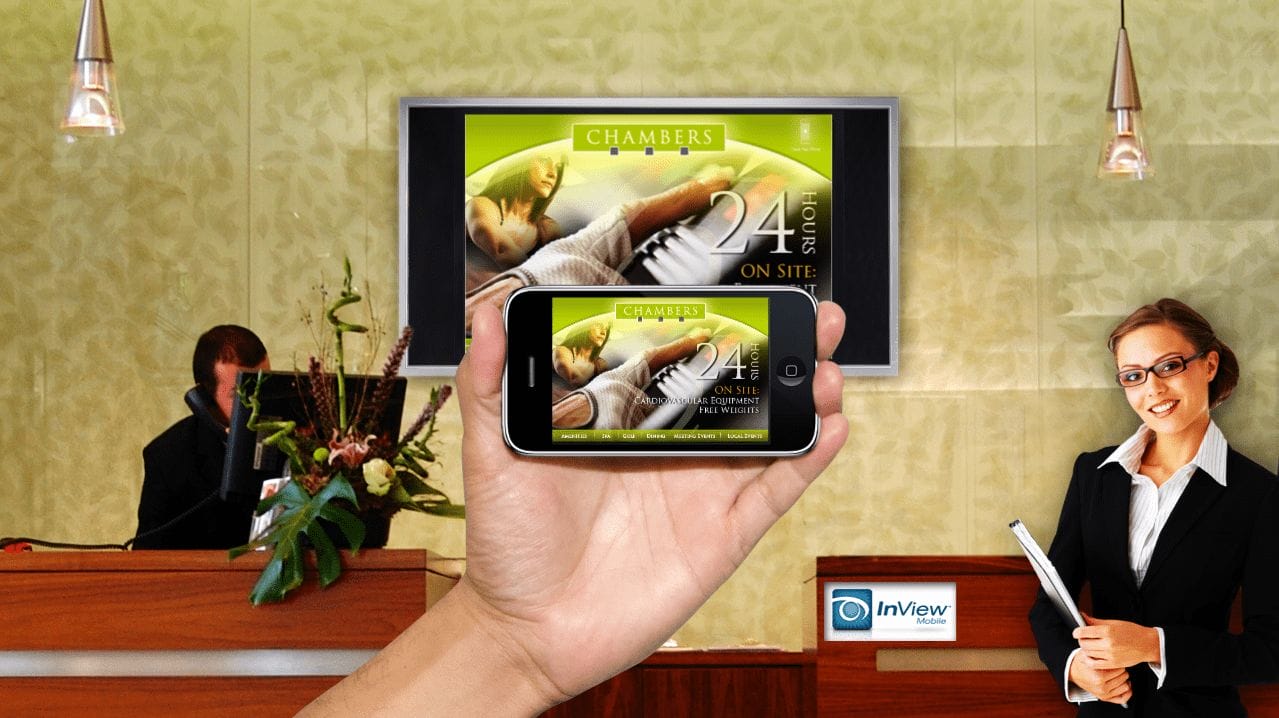
| Advertise Me: | In one of our recent digitalsignageblog.com post, we talked about “Using your Iphone as a mobile digital signage player?”. We understand that Symon has recently released such a product. Tell us a bit about this product and why your company decided to release such a product. |
| Steve: | Our product is InView Mobile. InView Mobile is a media play application for smartphones that retrieves and plays interactive, multi-media content that is based upon the location of the user. The purpose of InView Mobile is to provide digital signage viewers with additional information in a fashion that cannot be obtained through a traditional digital signage viewing experience. In the InView Mobile-enhanced experience, Viewers are encouraged to download and launch the InView Mobile application. Once launched, InView Mobile queries a Symon-hosted content management system to acquire and deliver a mobile version of the show currently playing on the screen. InView Mobile goes one step further in that it presents an interactive, touchscreen version of the big screen’s non-interactive show. All of this is managed through one content management system. We chose to create this product because digital signage has one big problem: It can’t quantify what people do once they’ve looked at a screen. InView Mobile gives us a platform to begin addressing this.
![]() Symon InView |
| Advertise Me: | There are quite a number of people who believe that the Iphone should not be used a digital signage player, what do think about this? Are people not realising the true benefit of mobile marketing and mobile interactivity? |
| Steve: | Our customers sure think it’s a good idea and that’s all that matters to me. |
| Advertise Me: | Can you please share with us one of Symon‘s latest digital signage deployments/projects? |
| Steve: | Each month, Symon signs many new accounts. These new accounts represent marquee brands in corporate, hospitality, education, gaming, health care, etc. We have almost 8,000 customers representing 80% of the Fortune 100 and almost 70% of the Fortune 500. Look at almost any large company and there is a good chance that they will have a Symon system somewhere. |
| Advertise Me: | Do you have any advice for people who are planning to start a business in the digital signage industry? |
| Steve: | Don’t, unless they have a compelling angle that someone hasn’t thought of already (and please don’t let it be some new idea for an ad model). The competition is too great. The start ups can’t compete on the big deals and its tough to make a living off of a lot of little deals. In the five years I’ve been associated with this business, I’ve seen too many companies fail and there aren’t a whole lot of the survivors that are making money. The big guys will thrive, the little guys will have a tough go of it. I could write a book on this subject, but suffice it to say, you’ve got to have scale to win and a startup does not typically have enough resources to get scale. |
| Advertise Me: | This is our final question. What do you see as the next “BIG THING” in digital signage? |
| Steve: | Mobility. Interactivity. |
| Advertise Me: | Steve, thanks for taking part in this interview and we hope to speak to you again in the near future. |
To read more interviews click here: http://www.digitalsignageblog.com/category/digital-signage-interview/
About Symon
Symon Communications is a 29 year provider of in-venue visual communications solutions to over 7,500 customers globally, including 80% of the Fortune 100.
About Advertise Me:
Advertise Me is a privately owned Australian company specialising in all aspects of digital signage solutions.
Our team of highly skilled professionals is able to introduce innovative ways for businesses to communicate with their intended audiences for a variety of purposes including informing, educating, entertaining and selling.
You can expect us to:
- offer the most affordable and cost effective solutions tailored to your specific business needs.
- provide you with concise and accurate information and will ensure that you understand and are comfortable with our proposals.
- strive to make our clients happy and successful.
We have partnered with a number of key reputable organisations and will continue to build further partnerships to deliver the most effective solutions for our customers.
Visit our website at www.advertiseme.com.au for more information.
Category: Digital Signage Interview, Featured Post
Interesting interview by Minicom
Minicom digital signage recently interviewed Rob Gorrie, president & founder of Adcentricity and it’s worth a read. In this interview Rob shares his knowledge, insights and experience of effective content for DS.
Have a read of the interview on the digital signage articles website:
http://www.digitalsignagearticles.com/2009/07/the-minicom-interview/
Category: Digital Signage Blog News, Digital Signage Interview
Advertise Me Interviews Bill Gerba from Wirespring
advertise me: Before we start, we would like to thank you Bill for taking the time to participate in this interview. We know you are a busy man so we’ll hopefully keep this interview nice and short. Could you please briefly introduce yourself for those of our readers who don’t know “Who is Bill Gerba?“.
Bill Gerba: Hi Marco, thanks for the chat. Well, for those who don’t know me, I’m the CEO and co-founder of WireSpring Technologies, a digital signage software and services company in Fort Lauderdale, Florida. On top of our software development operations, we also do a lot of industry research, which we publish on the WireSpring blog (which was recently renamed the “Digital Signage Insiders” blog). It’s the oldest digital signage blog out there, started in 2004, and has about 18,000 readers
Advertise Me: When and how did the company Wirespring start? How did the company derive it’s name?
Bill Gerba: We started out in May of 2000. At the time, wireless (cellular, WiFi and Bluetooth) were the “next big thing,” so the name tried to incorporate some of that. Our original product was a system that used the Bluetooth signal from your phone to triangulate your position in a retail space and then make promotional offers or provide wayfinding services based on that. Needless to say, with the very dumb cellular devices, low penetration of Bluetooth, and high equipment costs of the time, we met some resistance with that early product. We refocused our efforts on more traditional self-service kiosk and digital signage products soon after that.
Advertise Me: We recently read in your blog that you have been busy releasing a new product. Tell us more about this.
Bill Gerba: Up until very recently, our products were designed for large enterprises people who wanted to manage networks of hundreds or thousands of digital signs or kiosk terminals. While that business has served us well over the years, and we certainly continue to see good growth there, we also wanted to be able to pursue the many, many smaller opportunities that we had to pass on because our enterprise software was too complex. Hence, we decided to take all that we had learned from our enterprise FireCast and ClientCenter products and distill them down to a new, simplified product, and so Digital Signage EasyStart was born.
Advertise Me: What are some of the features that makes this new product stand out from other digital signage products?
Bill Gerba: Well for one, we’re selling the hardware and software as an integrated solution. If you buy EasyStart from us, it comes pre-loaded on a box that we’ve certified to work in every arrangement we can think of. If you’re buying from one of our distributors or resellers with their own hardware platform, we’ve certified that to work as well. For another, we’ve simplified the user interface by making a lot of decisions behind-the-scenes for the user. They want a 4-zone layout with certain aspect ratio? Ok, we’ll figure out the dimensions for each area and tell them. Want to switch between multi-zone and full-screen content? No problem, just check one checkbox. We’ve gone through and made hundreds of tweaks to our system to make it so easy that anyone can be up and running in minutes. We also made sure that it was easy to get in touch with support right from our user interface (over the web), and we bundle in video tutorials for all of the most commonly-used features.
Advertise Me: What are your thoughts on digital signage SaaS? Is Wirespring heading towards this path?
Bill Gerba: By my reckoning, WireSpring was the very first digital signage SaaS company — our ClientCenter web portal went online in August of 2001. Today, about 2/3 of our revenues are from our SaaS products. EasyStart is actually a break from that — there are no recurring fees — because while SaaS tends to work well for mid- to large enterprises, the small guys don’t want to be burdened with another monthly charge.
Advertise Me: Now, you’ve been in the digital signage business for a while, so what challenges and setbacks have you faced thus far?
Bill Gerba: Well, we certainly overestimated the demand in the early years. It was very, *VERY* hard to sell networks back when plasma screens cost $8-9000 each. Likewise, because the SaaS model was so new at the time (it was still called “application service provider” or ASP back then), we had to jump over some hurdles to get customers to understand the benefits of the approach. Thankfully, that has gotten a lot easier.
Advertise Me: Do you have any advice for people who are planning to start a business in the digital signage industry?
Bill Gerba: Two rules cover 90% of what I have seen gone wrong:
Rule #1: If you’re going to start an ad-funded network, you had better have a team of people who are *already* experienced with selling ads.
Rule #2: Everything takes 3x as long as you think it should. Plan out your time and budget accordingly.
Advertise Me: This is our final question. What do you see as the next “BIG THING” in digital signage?
Bill Gerba: That’s a tough one. Certainly interactivity seems to be gaining a lot of ground, though I’ve still seen more cool tech demos than actual deployments using it. Gestural interaction, mobile interaction, anything that can get a viewer to engage with the content is becoming really important. People are also starting to think outside of the box — literally. While LCD screens still make up the majority of DS deployments today, more people are using 3D, unique bezels, or projection onto holographic film to create images that aren’t square in an attempt to be more eye catching. I think that as people get more used to the idea of big screens hanging around everywhere (including their living rooms) network owners are trying to step up their presences with interactivity and unique display formats to remain visible.
Advertise Me: Once again Bill, thanks for your time and we wish you all the best with the release of the new Wirespring product.
To read more interviews click here: http://www.digitalsignageblog.com/category/digital-signage-interview/
About Advertise Me:
Advertise Me is a privately owned Australian company specialising in all aspects of digital signage solutions.
Our team of highly skilled professionals is able to introduce innovative ways for businesses to communicate with their intended audiences for a variety of purposes including informing, educating, entertaining and selling.
You can expect us to:
- offer the most affordable and cost effective solutions tailored to your specific business needs.
- provide you with concise and accurate information and will ensure that you understand and are comfortable with our proposals.
- strive to make our clients happy and successful.
We have partnered with a number of key reputable organisations and will continue to build further partnerships to deliver the most effective solutions for our customers.
Visit our website at www.advertiseme.com.au for more information.
Category: Digital Signage Blog News, Digital Signage Interview, Featured Post
Digital Signage Blog Guest Bloggers
Guest BloggersDigital Signage Featured Links
Recent Posts
Featured Posts
- Product Review: Synrax Onyx Mini
- Introducing digitalsignagearticles.com
- Experience the digital signage world at the ABC Bondi Shop
- Will the Microsoft Xbox 360 take over the Digital Signage Industry?
- Subscribe to the digital signage blog
- Want to be featured on the digital signage portal newsletter?
- About Advertise Me
- Klips: Share your digital signage snap!
Most Viewed Posts
- Forum Post: World Wide Digital Signage Network - 33,426 views
- Digital Signage Portal Forum Post: CISCO Film Making Competition - 17,737 views
- Digital Signage Portal Forum Entry: Help with digital signage business plan - 12,554 views
- Points to consider for a Digital Signage Business Plan - 11,896 views
- Digital Signage:How do I create a video wall? - 11,695 views
Recent Comments:
- Samsung LED screens (2)
- Audi A4 Diesel Engine: you have a great blog here at www.digitalsignageblog.com!
- LED Outdoor Screen: It’s gratifying to see your such a great information. We really impressed with your such a...
- Hungry for a Digital Menu Board (17)
- Teleshopping India: Digital signage is very popular & significant nowadays. This info is meaningful. Today is...
- Coca-cola goes interactive with digital signage vending machines (3)
- Fresh vending locations: Fresh Vending – Locations, food franchise business, you will receive the help you need...
- Digital Signage Klips: Supermarket in Miami Florida (1)
- olga vega: hi, I would like to have information to publish my company a clip video and/or a photo screen on a tv on...
Popular Tags used in our posts
advertise advertise me Advertisements australia blackberry blog Caption Digital Id digital signage digital signage network digital signage player Digital Signage Software Digital Signage Solutions email Fun Google iphone klip Klips lcd screen lcd screens led screen Poll Id portal screens Signage Industry Signage Solution Signage System Sydney Australia video wall
Digital Signage Blog Categories
- Digital Signage Blog Events (29)
- Digital Signage Blog Info (123)
- Digital Signage Blog News (192)
- Digital Signage Blog Products (35)
- Digital Signage Blog Video (16)
- Digital Signage Case Study (11)
- Digital Signage Guest Posts (11)
- Digital Signage Ideas (4)
- Digital Signage Interview (8)
- Digital Signage Jobs (5)
- Digital Signage Klips (32)
- Digital Signage Newsletter (7)
- Digital Signage Polls (14)
- Digital Signage Reviews (12)
- Digital Signage Techie (25)
- Digital Signage Tutorials (1)
- Digital Signage Weekend Fun (29)
- Featured Post (41)